
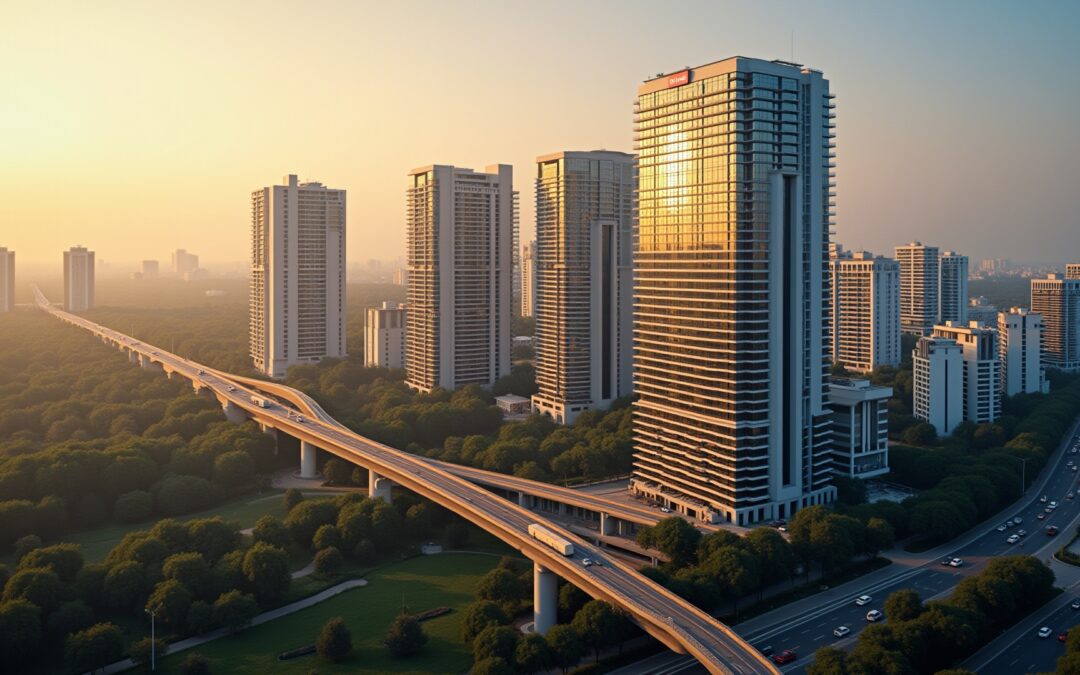
Bengaluru stands at the forefront of India’s real estate transformation, driven by its status as a global technology and innovation hub. The city’s real estate evolution is not merely a reflection of market growth but signals a strategic redefinition of urban landscapes across residential, commercial, and infrastructure domains. For developers, investors, and urban growth stakeholders, understanding the nuanced dynamics of Bengaluru’s property market is essential to capitalising on emerging opportunities and managing risks amid this expanding ecosystem.
Commercial Real Estate: Technology Hubs Driving Premium Office Demand
Bengaluru’s sustained leadership as a preferred destination for global IT firms and GCCs (Global Capability Centres) has intensified demand for Grade A office spaces. This trend encourages developers to prioritise projects along emergent growth corridors that integrate superior infrastructure and cutting-edge connectivity solutions. The emphasis on energy-efficient, technology-enabled workplaces reflects a broader industry pivot towards premiumisation and sustainability, enhancing asset quality and occupier appeal.
For institutional investors and REITs, these high-quality commercial assets present attractive income-generating opportunities with the dual benefit of stable leasing demand and capital appreciation potential. Developers who strategically acquire land and phase development in line with these demand centers can build resilient portfolios tailored to the evolving expectations of technology-driven occupiers.
Residential Sector: Navigating Dual Demand of Premium and Affordability
Bengaluru’s residential market embodies a dual-axis growth narrative. On one front, premium developments cater to a growing segment of high-net-worth individuals and executives drawn by lifestyle, locality, and quality benchmarks. On the other, the expanding urban workforce and middle-income demographic fuel strong demand for affordable and mid-income housing.
Developers who leverage data on urban migration, infrastructure upgrades—especially metro expansions—and demographic shifts are positioned to align supply with heterogeneous demand profiles. This balance could be key to optimizing absorption rates and managing pricing power in a competitive yet fragmented housing market.
Urban Infrastructure as a Growth Catalyst
Bengaluru’s urban infrastructure initiatives—spanning transit networks, improved road linkages, and planned township developments—are pivotal in reshaping the city’s real estate footprint. These projects not only ease core-area congestion but also unlock peripheral and emerging micro-markets, creating new corridors for residential and commercial growth.
From a capital formation perspective, improved infrastructure enhances asset quality and investor confidence, underpinning the potential for large-scale investment vehicles such as REITs and public-private partnerships. The intersection of infrastructure delivery with real estate development accelerates the city’s competitiveness and long-term resilience.
Strategic Investment Implications
The evolving Bengaluru real estate landscape offers multiple avenues for sophisticated investors and developers. Institutional capital is increasingly attracted to diversified portfolios that combine stable, income-yielding office assets with integrated residential-commercial townships. This diversification balances revenue streams and mitigates market cyclicality.
Furthermore, the continued leasing appetite from GCCs and technology firms supports robust rental growth, while emerging micro-markets offer significant capital appreciation potential. Embracing digital proptech tools enhances decision-making, enabling data-driven land acquisition strategies, phased development plans, and operational efficiencies.
Looking Forward: Strategic Priorities for Long-Term Competitiveness
As Bengaluru’s real estate market matures, stakeholders must vigilantly monitor infrastructure execution timelines, regulatory developments, and evolving occupier preferences to sustain competitive positioning. Prioritising sustainability and green building practices will not only meet growing tenant expectations but also future-proof assets amid tightening environmental regulations.
Moreover, fostering collaborative frameworks involving public agencies and private developers can enable scalable urban solutions that address decongestion and inclusive growth. For real estate leaders focused on durable performance and urban resilience, Bengaluru represents a dynamic case study of how technology-driven economic growth intersects with sophisticated real estate development strategies to build a future-ready city.